

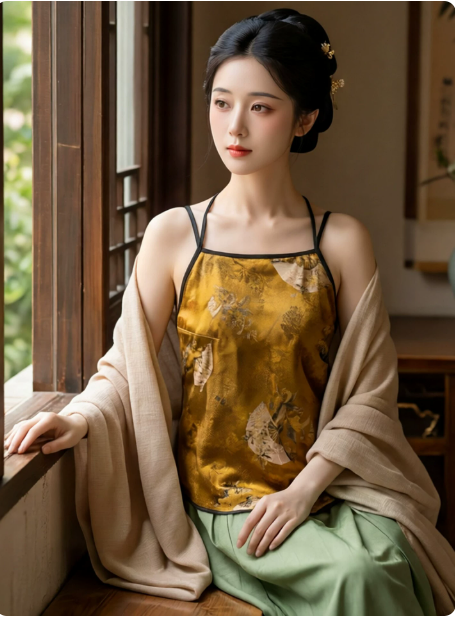
When people start wearing Hanfu or neo-Chinese outfits, one question comes up fast:
"What do I wear underneath?"
For Western daily wear, the answer is usually obvious — a bra, maybe a slip. But Hanfu was never designed around wired bras. Traditional Chinese clothing has its own undergarment system, and once you understand it, a lot of "wardrobe malfunctions" (strap showing, cup lines, tight band under a loose cross-collar) simply disappear.
At YaoyaoHanfu, we get this question from customers in the US, UK, EU, and Southeast Asia all the time. So here's a clear, non-snobby breakdown of hanfu lingerie vs western lingerie — history, structure, comfort, and what actually works today.
1. What counts as "Hanfu lingerie"?
In classical China, underwear was called 亵衣 (xièyī) — "private clothing," not meant to be seen. Across dynasties, the shapes changed names but followed the same logic:
- 抱腹 / 心衣 (Han era) — a front panel wrapped around the lower chest, tied at the back; heart-cloth version added neck strings
- 裲裆 (liǎng dāng) — front + back panel, the ancestor of the vest
- 诃子 (hēzǐ, Tang) — backless chest band worn under high-waist ruqun, tied under the bust
- 抹胸 / 宋抹 (Song) — a soft chest-wrap covering bust to upper belly, often cotton or silk
- 主腰 (Ming) — a laced waist-cincher, but soft, not boned
- 肚兜 (dudou) — the triangular chest cloth everyone recognizes, popular from late imperial period
- Tie closures, not hooks
- No underwire
- Flat, soft front — no push-up cup
- Designed to disappear under loose outer layers


2. What counts as "Western lingerie"?
- Stays / corsets (14th–19th c.) compressed the waist and pushed the bust up using bone channels, busks, and lacing
- Corset bra / corselet (late 1800s–1900s) split the corset into bust support + waist control
- Modern bra (1910s+) replaced corsets for daily wear; Mary Phelps Jacob's 1914 patent is the usual starting point
- Today: underwire, molded cups, band+cup sizing, push-up, sports bra, bralette


3. The 5 biggest differences
① Support vs containment
- Western bra: lifts, separates, fixes position with band tension
- Hanfu undergarment: holds a layer close to the body, warms the dantian (lower belly), doesn't "lift"
② Wire vs tie
- Western = elastic band, hooks, underwire
- Hanfu = strings, knots, side ties, wrap-and-tuck
③ Silhouette goal
- Corset tradition → hourglass, defined bust, small waist
- Hanfu tradition → straight, soft torso; the outer garment makes the line
④ Modesty logic
⑤ Gender & daily use


4. What to wear under Hanfu (real-life guide)
Under Song / Ming top (cross-collar)
Under Tang ruqun / qixiong skirt
Under neo-Chinese blouse + jeans (daily wear)
Hot climate (SEA)
- bamboo viscose bandeau
- cotton song-mo style wrap
- seamless bralette, no lace (lace shows under silk)

5. "Hanfu lingerie" today (the modern version)
- dudou shape in bamboo cotton
- song-mo wrap with adjustable side ties
- embroidered chest band as lingerie or outer festival piece
- neo-Chinese silk slip with high neckline + back tie
- Base layer under Hanfu
- Lounge wear
- Statement intimate set for photos / weddings
6. Quick comparison table


7. Which should YOU choose?
- Wearing full Hanfu to a festival → dudou or song-mo wrap
- Daily neo-Chinese outfit → normal bralette is fine
- Tang qixiong skirt → chest band, not wired bra
- Just want pretty Chinese-inspired lingerie → modern hanfu lingerie set
- Western corset lover → you can still wear a bustier over a Hanfu top for a fusion look, just don't expect historical accuracy


Where to start


