

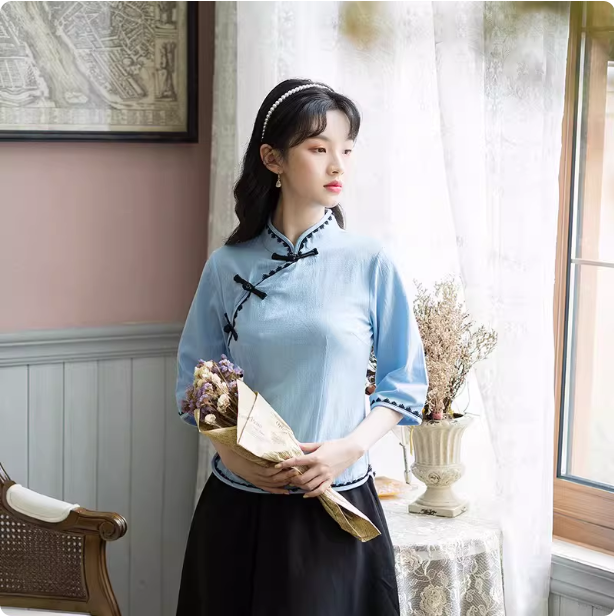
When we speak of Hanfu, many envision flowing robes from the Tang or Ming dynasties. Yet, the Republican Era (1912-1949) remains a hidden chapter in Hanfu’s evolution—a time of cultural fusion, political upheaval, and sartorial innovation. Far from disappearing, Hanfu adapted, quietly weaving itself into the fabric of a changing China.
A Time of Transition: The Republican Era Context
The fall of the Qing dynasty in 1912 marked not just a political shift but a cultural renaissance. As China grappled with modernization, clothing became a canvas for identity. While Western suits and qipao(often mislabeled as the era’s sole attire) gained popularity, Hanfu elements persisted in subtle, reinvented forms. This was not abandonment but creative adaptation—a dialogue between ancient aesthetics and contemporary life.


Key Styles of Republican-Era Hanfu
-
The “Modified Ruqun” (改良襦裙)
-
Women’s attire saw hemlines rise and silhouettes simplify. The traditional ruqun(blouse+skirt) was tailored closer to the body, with narrower sleeves and lighter fabrics like silk gauze or printed cotton.
-
Fun detail: Embroidery motifs shifted from imperial dragons to chrysanthemums, peonies, or even Art Deco patterns—a nod to global trends.
-
-
The Scholar’s Changshan (长衫) as Daily Wear
-
Once reserved for scholars, the changshan(long robe) became unisex casual wear. Men and women paired it with trousers or Western-style skirts, accessorizing with pocket watches or leather shoes.
-
Historical touch: Revolutionaries like Qiu Jin wore changshanas a symbol of gender equality and national pride.
-
-
Fusion Outerwear: Doupeng (斗篷) & Capes
-
Woolen capes or velvet doupeng(capes) layered over Hanfu-inspired dresses blended practicality with elegance—perfect for Shanghai’s rainy winters or Beijing’s autumn winds.
-

Why Republican-Era Hanfu Matters Today
-
Cultural Resilience: It embodies Hanfu’s ability to evolve without losing its soul. In an era of anti-queue laws and Westernization, these adaptations preserved Han identity through fabric and form.
-
Modern Revival Inspiration: Contemporary Hanfu designers increasingly draw from this period—experimenting with shorter sleeves, mixed textures, and neutral palettes for daily wear.
-
A Lesson in Balance: The era reminds us that tradition isn’t static; it thrives when it embraces change. As one 1930s magazine proclaimed: “Fashion should honor the past, not chain us to it.”
How to Incorporate Republican-Era Elements Today
-
For Modern Hanfu Enthusiasts:Try a linen ruqunwith a belted waist, paired with lace-up Oxford shoes and a vintage clutch.
-
For Cultural Events:A changshanin muted jade or gray, accessorized with a silk scarf, bridges ceremonial and casual.
-
Photoshoot Ideas:Seek locations with Republican architecture—Shanghai’s Bund, Nanjing’s tree-lined streets—to recreate the era’s ambiance.
Final Reflection: Threads of Continuity
The Republican Era’s Hanfu legacy is a testament to cultural endurance. In its stitches, we see a nation navigating modernity while holding onto its heritage—a reminder that clothing is never just clothing. It’s memory, identity, and hope woven together.
Want to explore further? Visit digital archives like the “Republic of China Fashion Collection” or join forums like #HanfuHistory on social media.
Tags: #RepublicanEraHanfu #HanfuEvolution #ChineseFashionHistory #CulturalFusion #WearableHistory #EastMeetsWest


